Imagine you have a favorite sport. Maybe it’s skiing. You’re not the best at it, but when people ask what your hobby is, you say you ski.The person you tell might get impressed by what you can do and ask you to show them your skills. Deep down you know that you're just a beginner, nothing impressive, and showing yourself could mean disappointing those initial good impressions of you. On top of all of that, on a recent skiing trip, you saw a new skier performing an impressive skill that you haven’t even mastered yet. This isn’t the first time shame keeps eating away at your confidence, now you don’t feel like skiing is worthy enough to be part of who you are, so you stop telling people you ski. Eventually you quit because you believe you aren't worthy enough to call yourself a skier. Over time, you start avoiding challenges of all types and decide it’s better to just stay inside at home.
This experience is about more than skiing.
It represents what can happen when a person’s worth becomes tied to other people’s perceptions, comparisons, or unmet self expectations. Self-esteem is essential to our health, coping abilities, survival, and sense of well being [7]. When someone constantly feels that they are falling short of who they believe they should be, their self esteem can become unstable. They may begin avoiding social situations, unfamiliar experiences, or anything that exposes them to failure. According to the National Health Services, low self esteem teaches “the unhelpful rule that the only way to cope is by avoiding things” [5].
But constant avoidance does more than keep someone away from uncomfortable situations. When a person repeatedly avoids challenging tasks, they also get fewer opportunities to practice dealing with them. This can make everyday tasks feel increasingly difficult, especially when it comes to starting, organizing, focusing, and following through.
These abilities, along with several others, are known as executive function skills (see Figure 1).
Executive function skills refer to the mental skills that help us manage our thoughts and behavior so that we can work towards a goal. Three common executive functions are working memory, inhibitory control, and cognitive flexibility:
Working memory - allows us to hold and use information in our mind while working [4]
Inhibitory control - resisting impulses to stay focused [4]
Cognitive flexibility - adjusting our thinking, changing strategies, and adapting when needed [4]
Figure 1. Eight Executive Functions
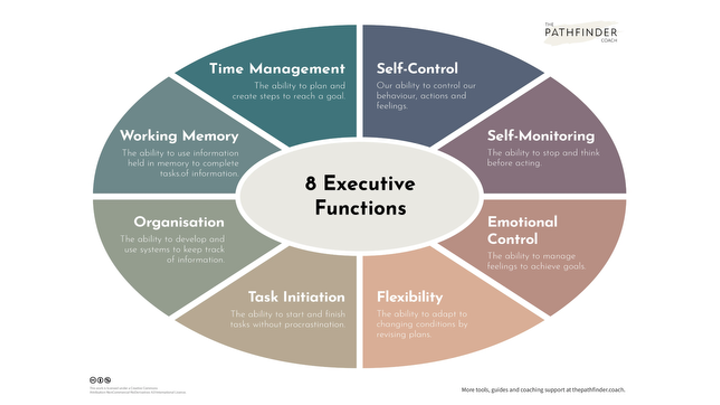
The Pathfinder Coach’s Description of 8 Executive Functions includes: Time Management, Self-Control, Self-Monitoring, Emotional Control, Flexibility, Task Initiation, Organisation, and Working Memory
These skills work together constantly. When you have an assignment to complete, for example, executive function skills can help you remember what needs to be done, resist distractions, decide where to begin, and adjust your approach when you get stuck.
When someone is struggling significantly with these abilities, we can describe it as executive dysfunction. It can make tasks such as starting, planning, organizing, prioritizing, and following through much harder [8]. It can show up in many ways like knowing what to do but feeling unable to start, only performing well under pressure, forgetting what was said in a meeting moments ago, or running chronically late to meetings despite genuine effort and awareness [1]. Oftentimes, people with executive dysfunction are told “just start doing the work, and you would realize it’s not that bad” which isn’t helpful.
It’s here that low self esteem and executive functioning can intersect.
A person who already doubts themselves may avoid difficult tasks because they expect to fail. Avoiding these tasks can prevent them from practicing the necessary skills they need to become more capable of handling them. Then, when they eventually try again and struggle, the disappointing result can feel like proof that their negative beliefs were correct.
The cycle begins to feed itself as shown in Figure 2:
Figure 2. The Negative Cycle
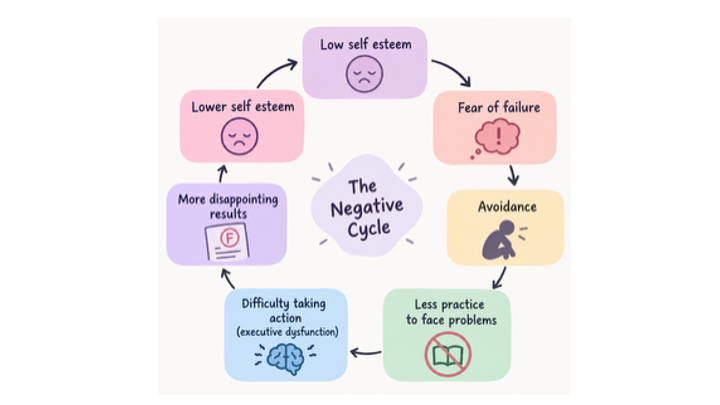
The Negative Cycle follows the path: Low self esteem → fear of failure → avoidance → less practice to face problems → difficulty taking action (executive dysfunction) → more disappointing results → lower self esteem
Breaking this cycle means working on more than confidence alone. It means gradually rebuilding the belief that you are capable of taking actions while also practicing the executive function skills that help you follow through.
So the question is; how do we get out of this trap?
The first step is rebuilding self trust through small actions. We can practice by trying some of these mindfulness and metacognitive strategies: .
Recognize what you are good at even if it's the small things [5]. We are all good at something, whether you believe it or not. And be proud of it! Not being the best at something does not mean you cannot get better.
Build positive relationships [5]. If you find certain people who bring you down, try to spend less time with them.
Be kind to yourself [5]. Think about what you’d say to a friend in a similar situation. We often give better advice to others than we do to ourselves.
Start saying no [5]. People who have low self esteem often feel they have to say yes to other people even when they don't want to. The risk is that you become overburdened, resentful, angry and depressed. For the most part, saying no does not upset relationships. It can be helpful to keep saying no, but in different ways until they get the message.
Learn to be assertive [5]. Being assertive is about respecting other people’s opinions and needs, and expecting the same from them. One trick is to look at other people who act assertively and copy what they do. It’s not about pretending you’re someone you’re not. It’s picking up hints and tips from people you admire and letting the real you come out.
Give yourself a challenge [5]. Set yourself a goal, such as joining an exercise class or going to a social occasion. Achieving your goals will help to increase your self esteem.
Creating your own alto ego character. When you’re feeling low, you can make a superior alter ego version of yourself. Every time you feel small, you can try to switch and jump into that person you dream of becoming [3].
The next step is to rebuild the executive function skills that help you follow through, so your confidence has something solid to stand on.When we begin to feel more confident, we feel more energized and positive to do the things we used to avoid. Activities begin to feel a bit easier to complete as confidence regains. Try taking a walk outside, the air suddenly feels fresher than how it used to feel when you were in the unconfident era.
Confidence is a great start, but it can fade quickly if the skills behind follow-through aren't there to support it. Without rebuilding your executive function skills, confidence is only a temporary relief and reoccurring failures could easily hold you back. To become more capable and functional with your own abilities, building (or rebuilding) executive function skills is beneficial to lifelong functioning in critical thinking, problem solving, planning, decision making, and executing tasks [2].
Helpful tips to reduce executive dysfunction:
Break down tasks into small tasks and priorities before you start [6]. Even if it seems meaningless, it’s important to celebrate small wins because pushing forward is hard. An example is taking a break every paragraph you complete, or even every few sentences you write for an essay. When having multiple tasks, arrange your tasks from highest to lowest priority so the major tasks are completed on time.
Download a habit app. A habit app can remind you of certain tasks that need to be completed especially for people who struggle with remembering things.
Practice mindfulness (Cleveland Clinic, 2022). If you don’t have anything nice to say, don’t say anything at all. It is okay to take a moment of silence to process what harmful words could potentially be spoken aloud.
Work alongside someone [6]. Working along with someone activates social motivation, find a friend and be bold to ask them out for a study session or workout.
Keep a notepad handy [6]. Have sticky notes handy to keep unrelated thoughts that you can return to after completing a main task.
Set timers and alarms [6]. Timers and alarms create small doses of pressure that allow us to try to work and complete tasks on time.
Minimalistic workspace. Creating a minimalistic workspace helps the brain focus. When the workspace is cluttered with lots of paper, tools, devices, etc., we lose clarity in our thoughts.
Change your environment. Moving to a new location, such as a library or coffee shop helps some people focus better.
Rebuilding self-esteem and executive function skills is not something that happens overnight. There may be still disappointing grades, unfinished tasks, moments of comparison, and days when taking action feels difficult. But one disappointing result does not define your ability or your worth. The goal is not to become a completely different person, but to gradually rebuild trust in yourself. When you begin taking small actions, practicing the skills that help you follow through, and treating yourself with more understanding, you can slowly break the cycle of avoidance and self doubt. Confidence does not always have to come before action. Sometimes, taking action is what allows confidence and executive function skills to grow.
References
[1] ADHD executive dysfunction: What it is & how to manage it. (2026, July 7). Neural-Revolution.Com. https://www.neural-revolution.com/feeds/blog/adhd-executive-dysfunction\
[2] Administration for Children and Families. (2016). Executive function. In Acf.gov. https://acf.gov/trauma-toolkit/executive-function
[3] Brosio, J. (2018, March 12). The most insane methods to build confidence and self esteem that you’ve probably never heard of. Medium. https://jonbrosio.medium.com/the-most-insane-methods-to-build-confidence-and-self-esteem-that-youve-probably-never-heard-of-f949592b5432
[4] Cleveland Clinic. (2022). Executive dysfunction: What it is, symptoms & treatment. In Cleveland Clinic. https://my.clevelandclinic.org/health/symptoms/23224-executive-dysfunction
[5] National Health Services. (2023). Raising low self-esteem. In NHS. https://www.nhs.uk/mental-health/self-help/tips-and-support/raise-low-self-esteem/
[6] NeuroLaunch editorial team. (2024, August 4). Mastering executive dysfunction: Comprehensive tips and strategies for ADHD management. NeuroLaunch.Com. https://neurolaunch.com/tips-for-executive-dysfunction/
[7] Schiraldi, G. R. (2026). 10 Simple solutions for building self-esteem. Google Books. https://books.google.com/books?hl=en&lr=&id=SMb2dFf17-YC&oi=fnd&pg=PR5&dq=building+self+confidence+through+mindfulness&ots=qNOjKPulZs&sig=DobFcpur0tRneRyhQ8ZXvJQg8G4#v=onepage&q=building%20self%20confidence%20through%20mindfulness&f=false
[8] Team, A. E. (2023). Executive function disorder & ADHD | adda. In ADDA - Attention Deficit Disorder Association. https://add.org/executive-function-disorder/
Mindy Lin is a high school student passionate about supporting neurodivergent learners. She co-authored this post during her research internship with ZenEdge Coaching through the Child Mind Institute’s Youth Mental Health Academy, a career development program for aspiring mental health professionals. Mindy hopes to champion practical, everyday solutions that improve the lives of neurodivergent and underrepresented communities.
